
Translation that moves with the conversation.
MoYi is a local-first speech translation system that interprets conversations as they happen, while preserving context, terminology, and critical details.
Designed for local and edge execution.
The experience
Speak. Translation begins to appear. Meaning becomes more precise as the conversation continues.
Speech arrives continuously from the active conversation.
Translation evolves while the speaker is still talking.
Stable meaning stays visible and can be prepared for playback.
The other person can read or listen without breaking the flow.
The current demo shows tentative and committed translation states during live conversation.
Why MoYi
MoYi is built around the parts of live conversation that sentence-by-sentence translation often loses.
Translation begins before the speaker finishes.
Previous turns and the current conversation remain in scope.
Names, technical terms, numbers, units, and negation can receive special attention.
Speech, terminology packs, and session context are designed to stay close to the device.
How it works
Speech moves through one continuous path before translation is exposed.
Capture the active conversation and determine the relevant acoustic source.
Process speech continuously as it arrives instead of waiting for a completed recording.
Use recent turns, names, glossary entries, numbers, units, and other critical details to resolve meaning.
Generate and revise translation candidates while speech is still arriving.
Determine whether output should be committed, revised, or held for more context.
Expose only the portion selected for output.
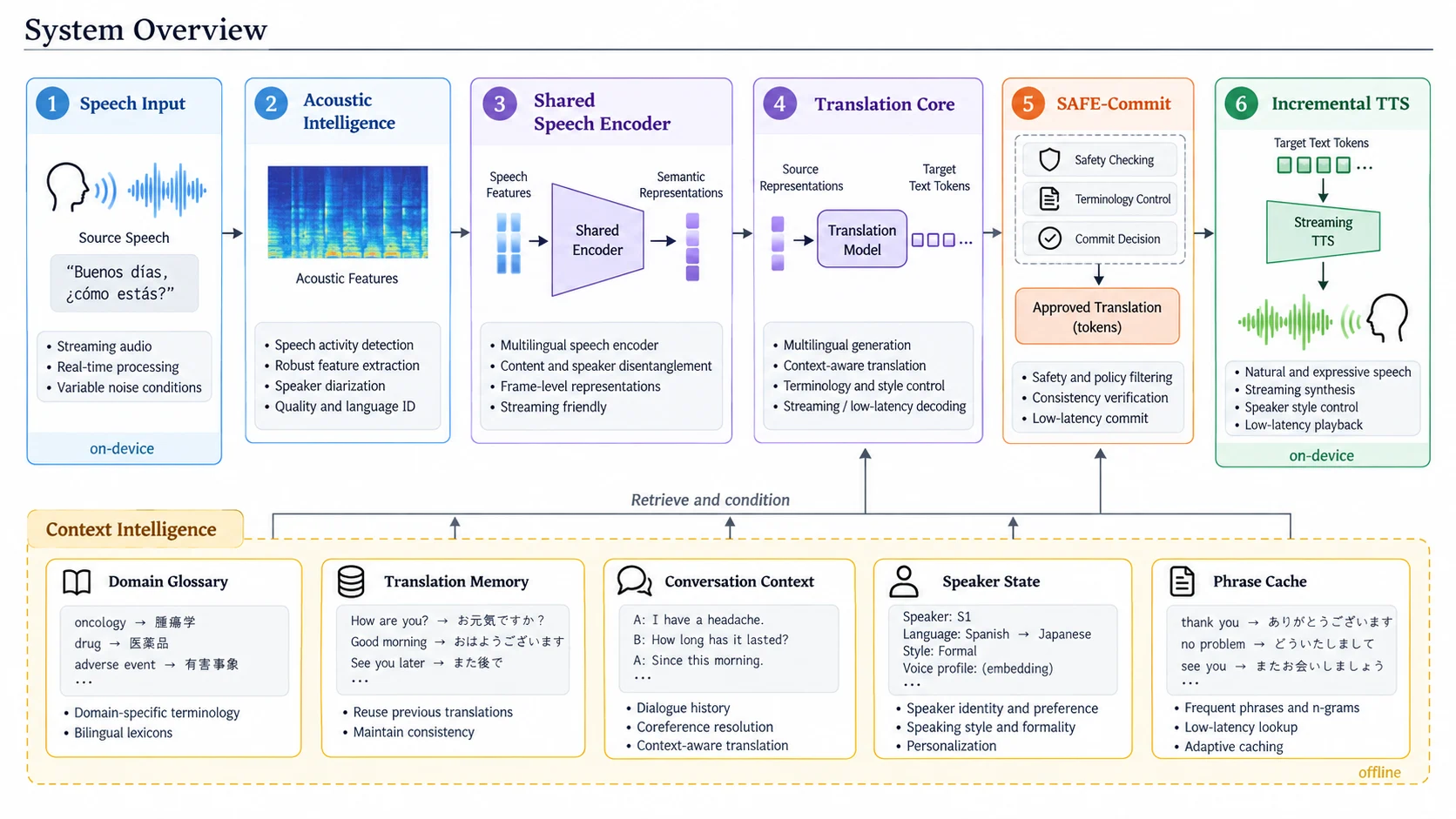
Speech moves through a continuous local pipeline from acoustic input to committed caption or translated speech.
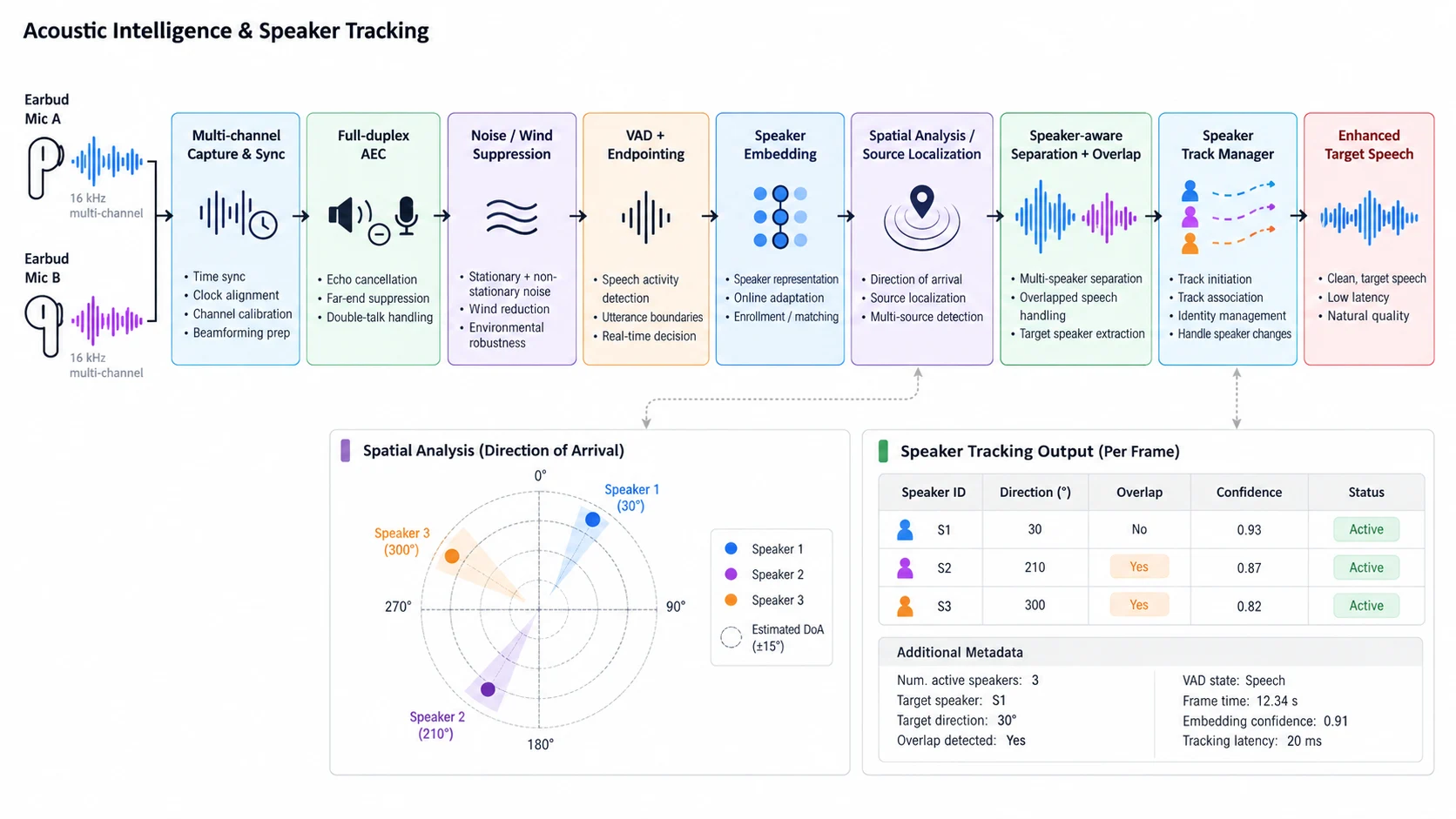
Acoustic processing explores echo control, noise suppression, spatial analysis, and source continuity before translation.
Two states
The interface separates what MoYi is still working out from meaning that should no longer move.
Still allowed to change as more speech and context arrive.
Stable enough to remain visible or move to speech output.
Research
MoYi research focuses on two practical questions:
- How can incoming context reduce unnecessary decoding?
- When is translated meaning stable enough to expose?
MoYi is exploring a draft-and-verify path that can commit earlier when context is clear and spend more computation when speech is ambiguous.
Recent hypotheses, token revisions, and contextual agreement can estimate how much translated meaning is stable enough to retain.
A proposed policy evaluates whether important meaning, including terminology, identifiers, numbers, units, negation, and operational instructions, is stable enough to expose.
- Commit — Release a sufficiently stable prefix.
- Defer — Wait for more context.
- Block — Withhold a high-risk candidate when current evidence is insufficient.
CASD and SAFE-Commit are not presented as validated production safeguards.
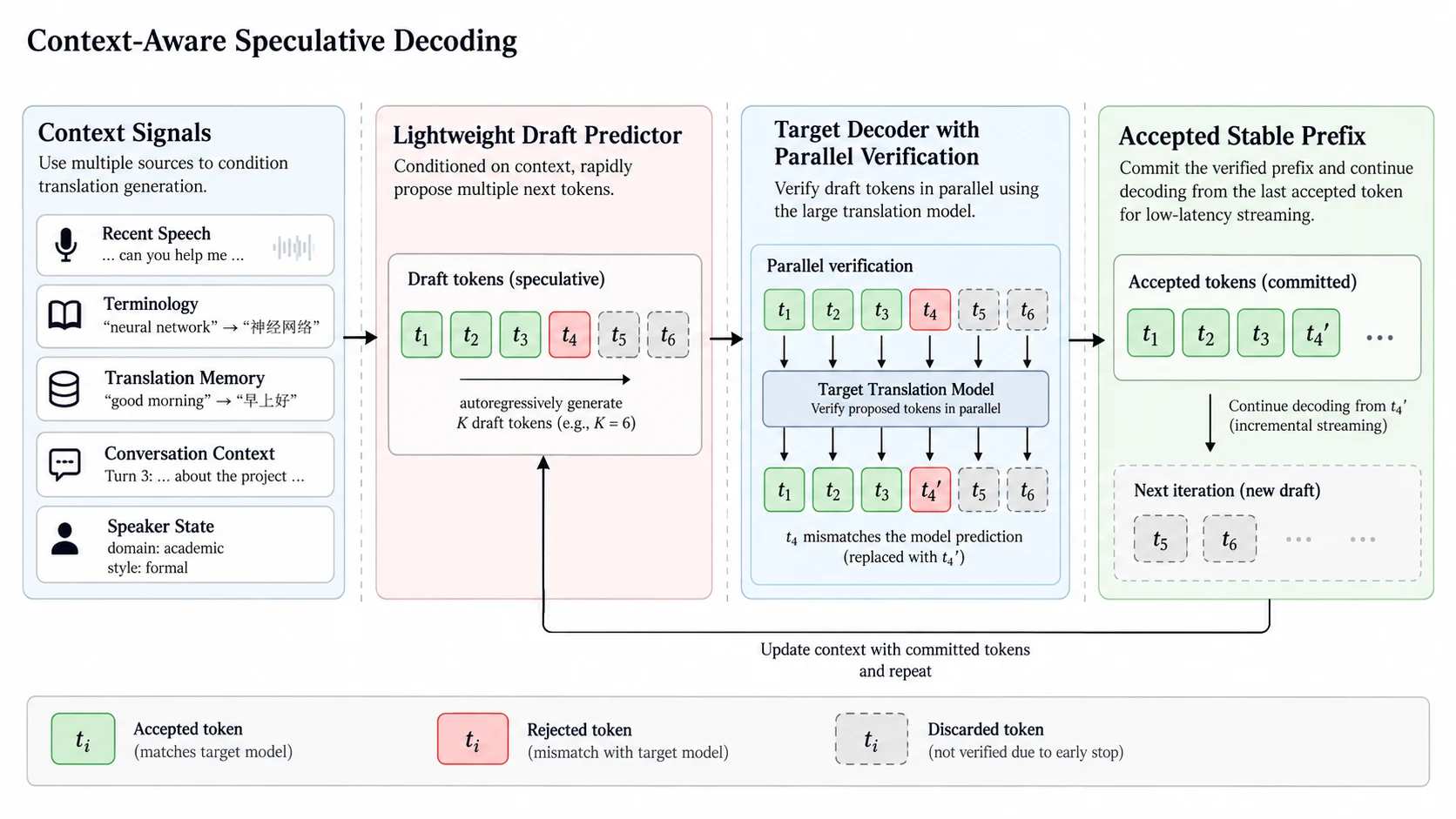
A draft-and-verify path explores how context can reduce unnecessary decoding.
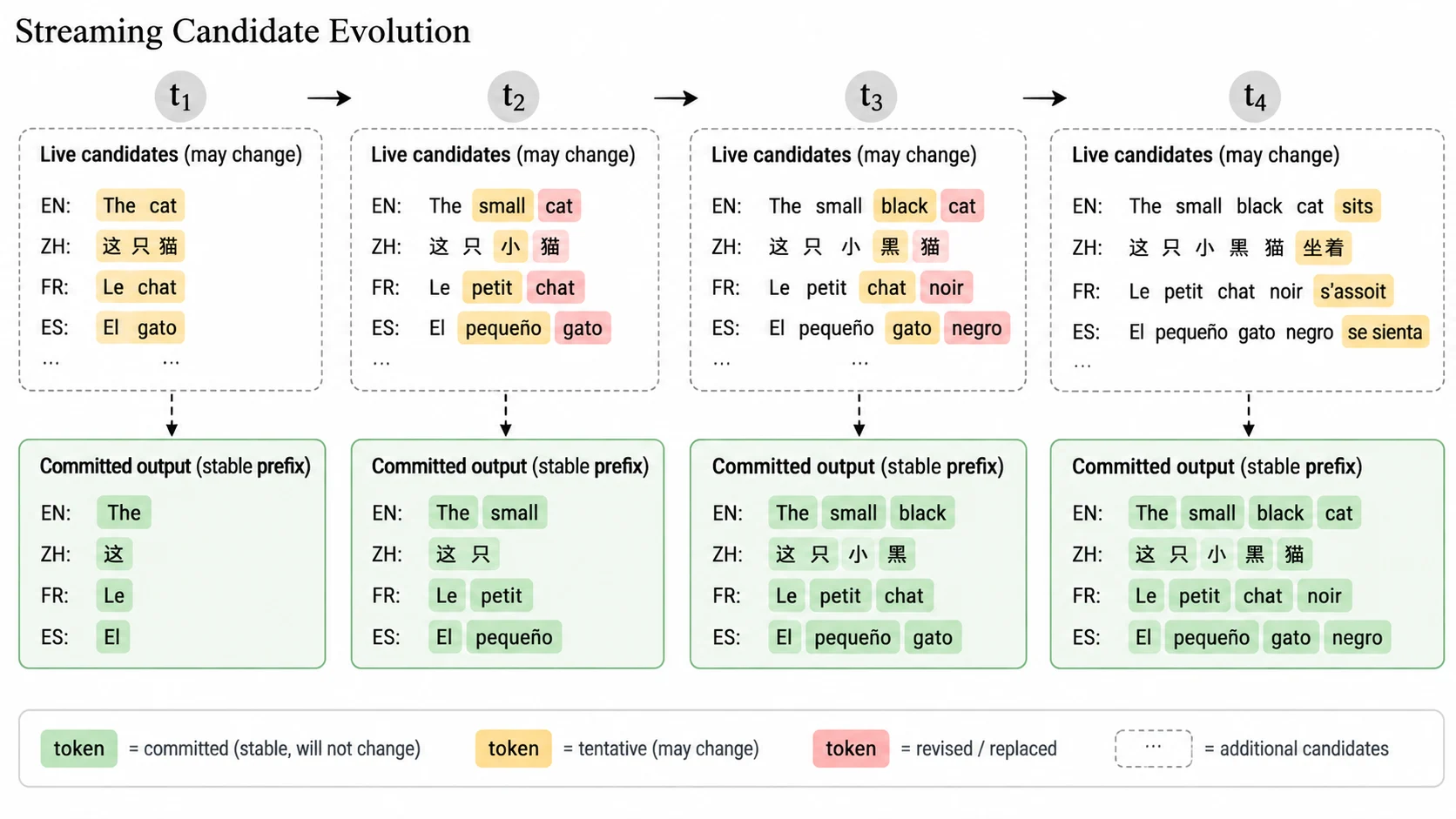
Tentative candidates can change while a stable prefix is retained.
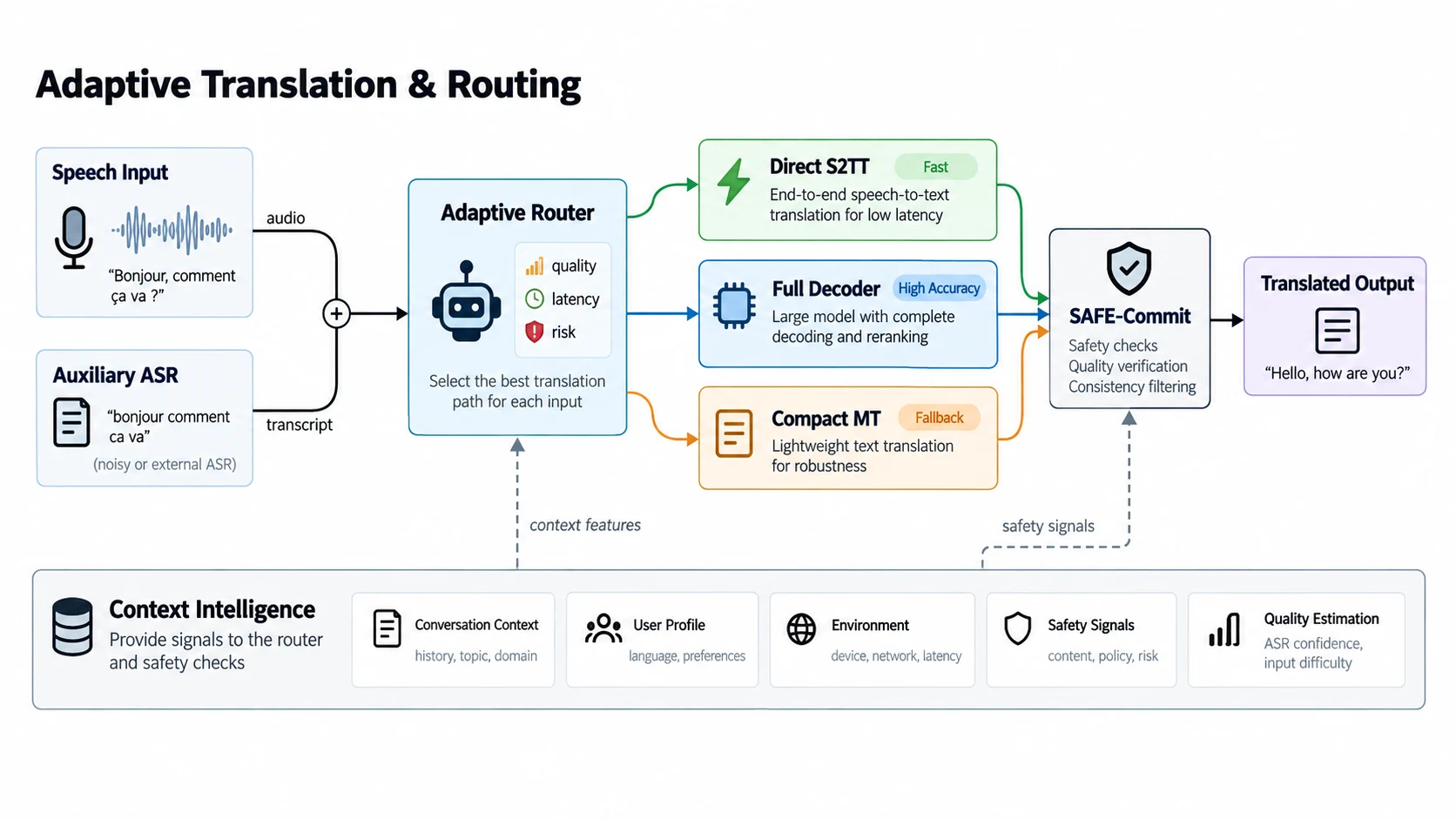
Available context and uncertainty can influence how translation is processed.
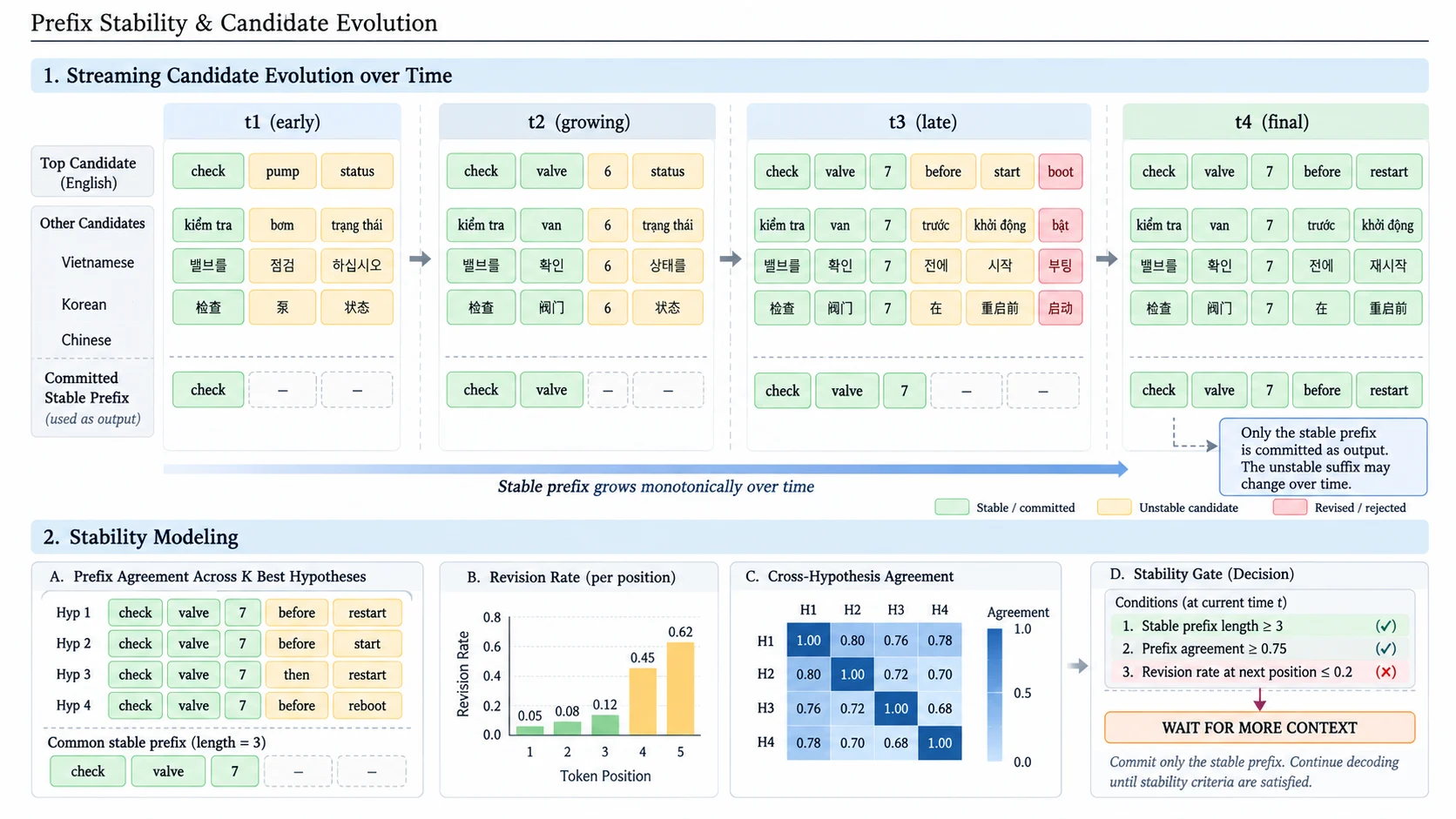
Recent hypotheses and token revisions help estimate how much meaning can remain fixed.
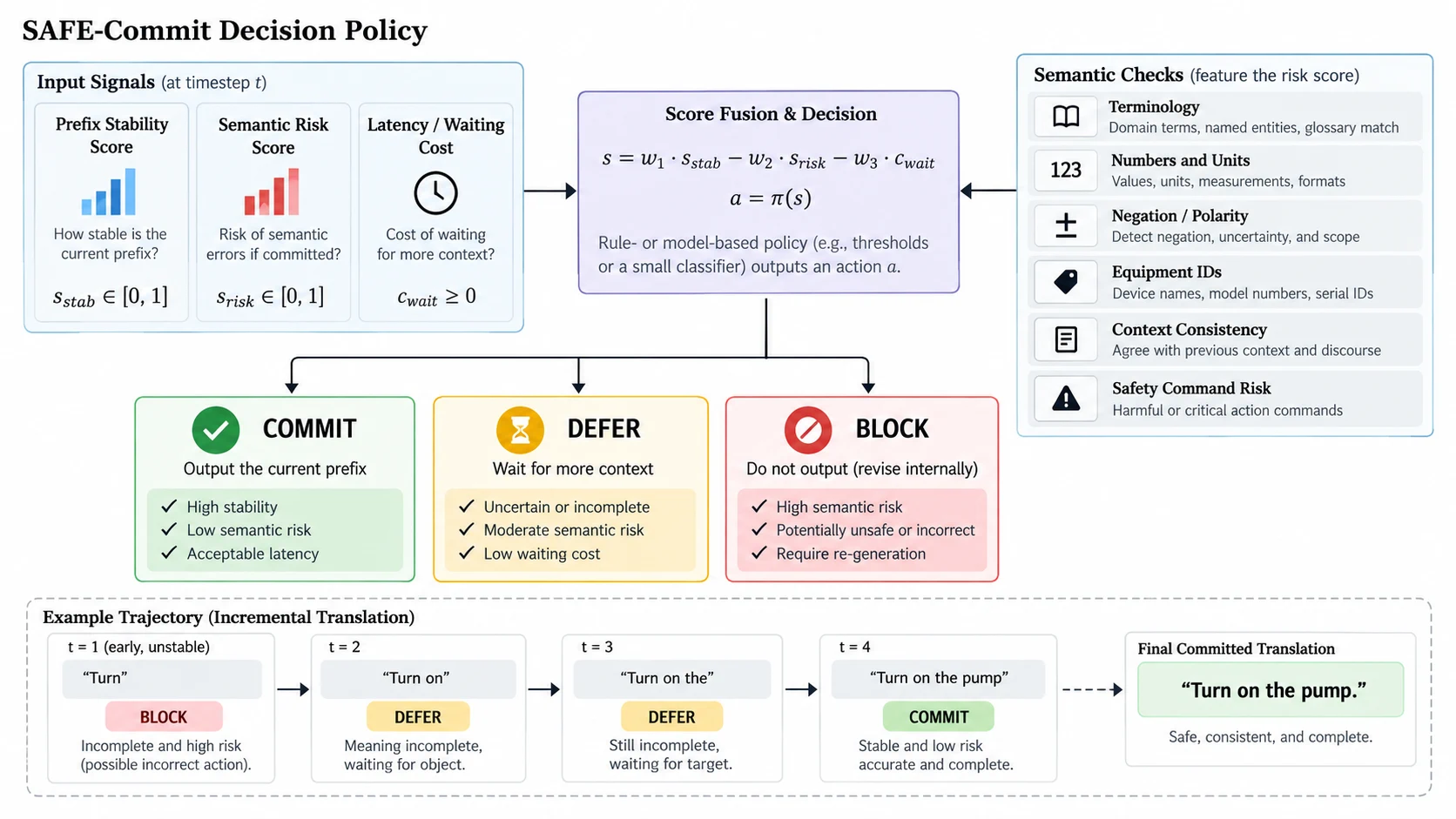
The proposed policy can release output, wait for context, or withhold a high-risk candidate.
Product direction
MoYi is being designed around a phone-centered local translation stack.
Proposed home for local models, session context, terminology, routing, captions, and translated speech.
Capture the conversation and play translated audio.
Desktop, embedded, and wearable deployments remain exploratory product directions.
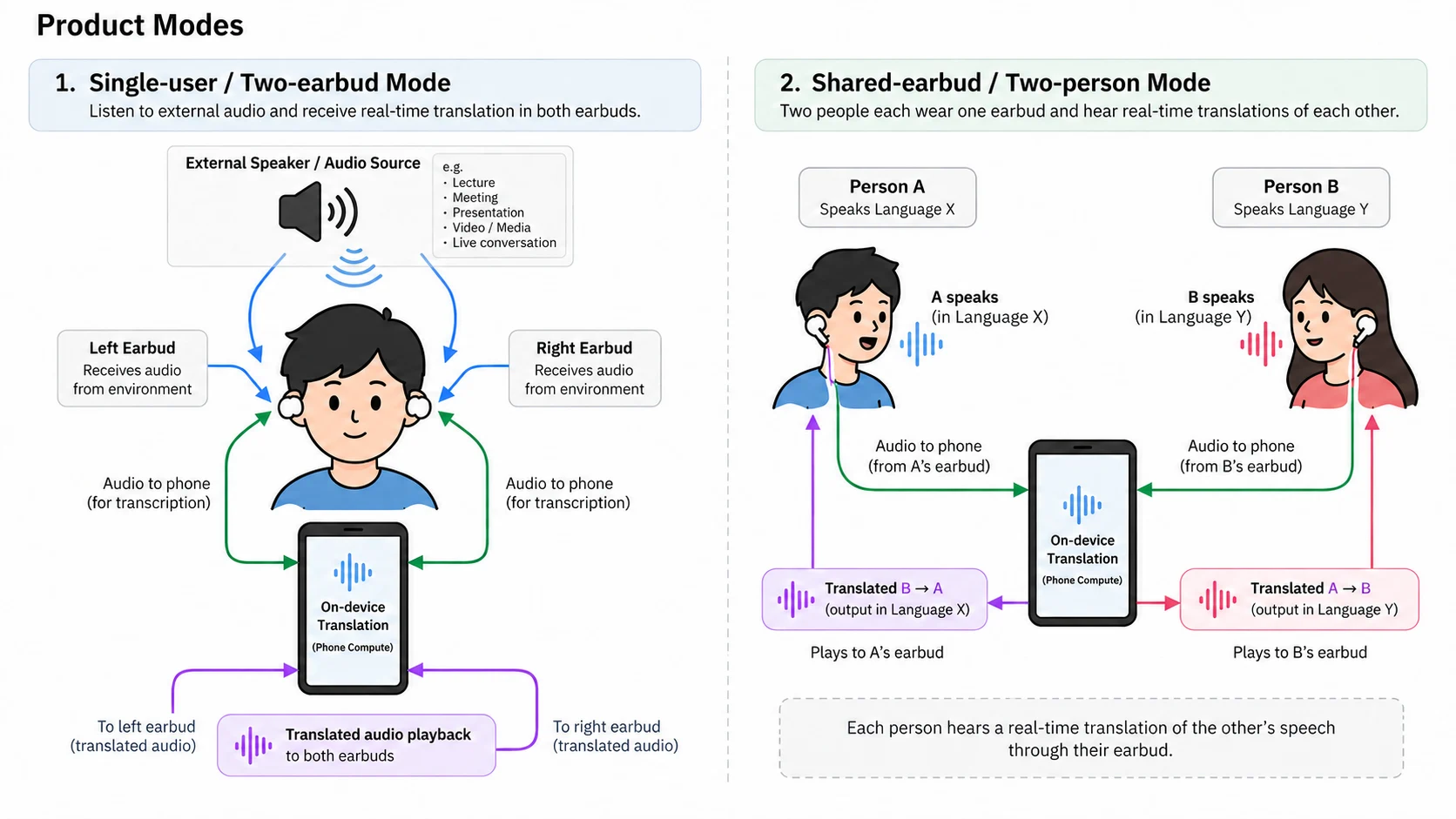
The phone-centered stack is being explored for personal listening and two-person interpretation.
Status
This page separates what can be demonstrated today from what remains experimental or unvalidated.
- Multi-speaker interaction UI
- Terminology and context UI
- Streaming multilingual output
- Tentative and committed states
- Speaker attribution
- Streaming S2TT
- Contextual routing
- CASD
- SAFE-Commit
- Local model management
- Phone-centered topology
- Latency
- Translation quality
- Speaker attribution accuracy
- Memory, power, and thermal behavior
- Offline reliability
- Language-direction coverage
No public end-to-end benchmark or physical-device validation result is currently claimed on this showcase page.
Initial target languages: Vietnamese, English, Korean, and Chinese. Translation coverage between individual language pairs remains under validation.